Sunday, 29 May 2011

White blackface?


Following my last blog about blackface I had an exchange of messages on Facebook with a reader of this blog, who commented:

“I still don't see how a ‘blackened face’ is any different from blackface - even when looking at it ‘objectively’, outside of our own time and culture. If they really meant it for more theatrical purposes, having nothing to do with race, then why did they always use black? Surely that wasn't the only color they had available.”

My comment back to her was that she was speaking as someone who found it difficult to imagine living in a world where she had never seen a person of African heritage and where something like soot was plentiful. I doubt if not considering those two things was really being ‘objective’.

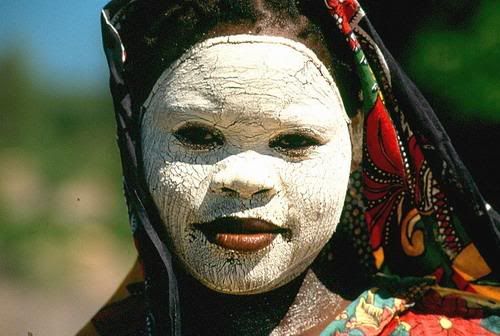
Whilst acknowledging that the term ‘morris’ in ‘morris dancing’ has been linked to the word ‘Moorish’, I am still going to suggest that we can distance blackened faces in British rituals from theatrical blackface, and I am going to do it by the following analogy.

Here is a picture of Xhosa initiates in South Africa…


… surely if they really mean their white face-paint for ritual purposes having nothing to do with race then why do they always use white? Surely that isn’t the only colour they have available.

In fact we have no evidence to suggest that they are imitating white people any more than the Australian Aborigine below is, or Makua women in Mozabique are.


I hope that readers get the point of this analogy.

Saturday, 28 May 2011

Il Ciarlestrone

Adriana Crespi calls it Il Ciarlestrone, Pierfrancesco La Mura calls it Il Ciarlavotto, and Maria Grazia Galatà recites it as Il Giabbodonte. I have no idea why there are so many Italian versions of this piece. Adriana Crespi's is below - see if you can guess what the original is:


          Era brillosto, e gli alacridi tossi
          succhiellavano scabbi nel pantúle:
          Méstili eran tutti i paparossi,
          e strombavan musando i tartarocchi.


          «Attento al Ciarlestrone, figlio mio!
          Fauci che azzannano, fauci che ti artigliano,
          attento all'uccel Giuggio e attento ancora
          Al fumibondo chiappabana!»


          Afferò quello la sua vorpi da lama
          a lungo il manson nemico cercò...
          Cosí sostò presso l'albero Touton
          e riflettendo alquanto dimorò.


          E mentre il bellico pensier si trattenea,
          il Ciarlestrone con occhiali brage
          venne sifflando nella fulgida selva,
          sbollentando nella sua avanzata.


          Un, due! Un, due! E dentro e dentro
          scattò saettante la vorpida lama!
          Ei lo lasciò cadavere, e col capo
          Se ne venne al ritorno galumpando.


          «E hai tu ucciso il Ciarlestrone?
          Fra le mie braccia, o raggioso fanciullo!
          O giorno fragoroso, Callò, Callài!»
          stripetò quello dala gioia.


          Era brillosto, e gli alacridi tossi
          succhiellavano scabbi nel pantúle:
          Méstili eran tutti i paparossi,
          e strombavan musando i tartarocchi.


Thursday, 26 May 2011

Quote of the day, 26th May 2011

"A world of unseen dictatorship is conceivable, still using the forms of democratic government."
                    Kenneth Boulding (1910 - 1993)
                    economist, mystic, and poet.

Tuesday, 24 May 2011

The People's Republic of Stokes Croft

An interesting video clip from The Guardian web site - the area of Bristol which saw mass protests over a proposed supermarket. There is criticism that the activists themselves are people who have moved into the area, but the activism itself is very encouraging because it typifies grass-roots decision-making and mutual aid.

Sunday, 22 May 2011

Françoise Hardy


When I was eight or nine years of age I hoped I would grow up to look like Françoise Hardy. I was wrong on so many counts!

Saturday, 21 May 2011

Bert Williams (1874 - 1922)


The more I write about 'blackface' the more interesting material I come up with. The pictures above and below are of Egbert Austin Williams, known as Bert, an African-American performer (I use the term for want of a better - he was actually born in the Bahamas, not the USA). His most notable achievement was to be the first person of his race to take a lead part on Broadway. What he is best remembered for, however, is his comedy double-act with George Walker, for which he wore blackface!


Bert Williams' most famous song is 'Nobody' - here is a 1913 recording of it. And here is a wonderful version of it by Ry Cooder, supported by the Golden Gate Quartet. Below is a publicity photo of Bert Williams, immaculately dressed but with a casual pose. W C Fields called him "The funniest man I ever saw, and the saddest man I ever knew."


Friday, 20 May 2011

A revolution needs no leaders!

The above anarchist axiom is (of course, wink wink) mine. By it I mean that as soon as 'leaders' emerge a revolution is dead and buried, because it simply becomes a matter of replacing one power structure with another. This has been the case in 17c England, 18c France, 18c America, 20c Russia, and so on and so on. When Lenin declared "All power to the Soviets" - the people's free assemblies - that was the last thing he actually meant!

I have been following a fascinating documentary series on BBC Radio 4 in which Martin Sixsmith (author, journalist, and expert on Russia) has been outlining Russian history. The thrust of the series has been to try to explain why Russia always seems to default to autocracy, and its insights are valuable to anyone who is interested in history. My major quarrel with MS is that his default position is 'liberal democracy', which he sees as normative. This is a cultural view which tends to taint his objectivity. Time and time again in the series he points to moments at which Russia might have taken steps which would have led it to become a 'liberal democracy' along the Western European model; these seem to be - to him - moments when Russia made the wrong choice, or rather did not make the right choice.

To my own mind (and I will be the first to admit that I am biased) the pivotal moments in Russia's history were those at which there may well have been a 'power vacuum' but at which people themselves, independent of ideology and 'leaders', might have taken their own destiny into their own hands. The 1917 Revolution was one such time.

Nevertheless listening to the series, conscious of MS's bias and my own, has been very rewarding. One thing it did was to point me to the entirety of Tarkovsky's brilliant film Andrey Rublyov on YouTube.

It is interesting how the meaning of words can be subtly altered by use or abuse. The hijacking by the Bolsheviks of the political autonomy of the 'Soviets' gave rise to the assumed title of their superstate, the Union of Soviet Socialist Republics. This in turn, in late 20c American Newspeak, gave rise to the use of 'Soviet' to mean 'communist' and in particular 'Russian communist' - phrases such as "Do we want our country to be taken over by the Soviets?" could be heard. Thus a word which meant a free assembly, the absolute building block, at least in potential, of a democracy greater than we currently know and enjoy in the West, was subverted by abuse to equate to a type of tyranny.

Do I want my country to be 'taken over' (ha!) by 'the Soviets'? Damn right I do! I want those free assemblies. I want delegates I can recall. I want a loose, confederation of the lowest possible tiers of participatory democracy. I want basic, gentle administration instead of the dead hand of bureaucracy. I want an end to secrecy, to vested interest, to the theft of labour.  I am sick of the remoteness of 'representative' democracy, sick of the political class, sick of government's powerlessness in the face of capitalism. I want democracy!

Jings... sorry, I didn't mean today's entry to be such a rant...